The short rundown
A practical WES ECA process guide for applicants in Pakistan. Follow the current WES document instructions and HEC e-attestation route, because requirements can change by credential and application type.
What an ECA is for
Completing a WES Educational Credential Assessment requires following the wes eca step by step process from Pakistan, comparing your qualification with a Canadian education standard for your immigration or study purpose. In the Express Entry system, an ECA is how a foreign credential earns Canadian equivalency points. Other applicants need an evaluation for study, employment, or a professional body.
An ECA is not the same as attestation. HEC attests the Pakistani document. WES evaluates the credential under its own rules. IRCC decides which assessment bodies and report types it accepts for the immigration purpose you select.
WES vs IQAS and choosing the body that fits the case
WES vs IQAS is a choice between two designated ECA organisations, not a choice between attestation and evaluation. WES and IQAS can both serve many Canadian immigration applicants, but the right option depends on the receiving program, the exact Pakistani institution and credential, document-source rules, current fees, queue estimates, and the report type accepted for the purpose.
| Decision point | What to check |
|---|---|
| Canadian purpose | Confirm whether the program needs an immigration ECA, an employment assessment, or another report. |
| Institution and credential | Search the exact Pakistani university, program, and credential in the organisation's current document tool. |
| Submission route | Check whether the institution, HEC, or another approved source must send the record. |
| Current operations | Compare the official fee, delivery option, queue estimate, and validity rule at the time of application. |
There is no permanent winner in a WES IQAS speed comparison. The current result for your institution controls. A WES or IQAS ECA also does not grant a Canadian professional licence. The provincial regulator makes that decision.
The Pakistan rule for e-attestation versus physical attestation
WES's required-document result for Pakistani institutions distinguishes two HEC routes, and the difference decides one document.
- HEC e-attestation. You applied through HEC's digital Degree Attestation System and received the electronic certificate. In this case the CNIC form is not required.
- Physical HEC attestation. You obtained a physical attestation from HEC. In this case the CNIC form is required.
This is the most common reason a Pakistani WES file stalls when an applicant follows a pre-2026 guide that asks for the CNIC form on every file, or sends physical attestation paperwork on a file that used the digital system. The controlling instruction is the live required-document result for your exact institution and credential.
Before you apply
Three checks save a week of delay.
- Confirm the purpose. Express Entry, study, and professional bodies take different report types. Choose the one the receiving program names.
- Find the exact institution and credential in WES's required-documents tool. The result can differ between two programs at the same university.
- Match your legal name. Your passport, degree, transcript, and WES application should use the same name. A mismatch can delay matching even when the qualification is genuine.
Step 1, the application and the reference number
Create the WES application for your purpose and select the country, institution, credential, and report type accurately. The WES reference number links every document to the evaluation, and it should appear wherever WES asks for it, including on courier packages and institution requests.
Step 2, the required-documents result for your institution
Search your exact Pakistani institution and qualification in the WES required-documents tool, save the result, and note the date. Then answer four questions from it.
- Which document must be sent, such as degree, transcript, marks sheet, or another record?
- Which organisation must send it, such as the institution, HEC, or another approved source?
- Must it go electronically, in a sealed envelope, or through another approved channel?
- Does the instruction change with HEC e-attestation instead of physical attestation?
If the result conflicts with an old guide, video, or agent message, follow the current WES result and ask WES before sending an expensive document package.
Step 3, the HEC route your result asks for
When the result requires HEC, apply through the current Degree Attestation System by uploading legible scans of the credential and your CNIC, completing the institution verification requirements, and downloading the electronic certificate when issued. HEC attestation is an input to the WES file, not the evaluation itself. Keep the HEC application record, the certificate, and the document PDFs together with your WES reference number. See the HEC attestation service page.
Step 4, sending documents the way WES specifies
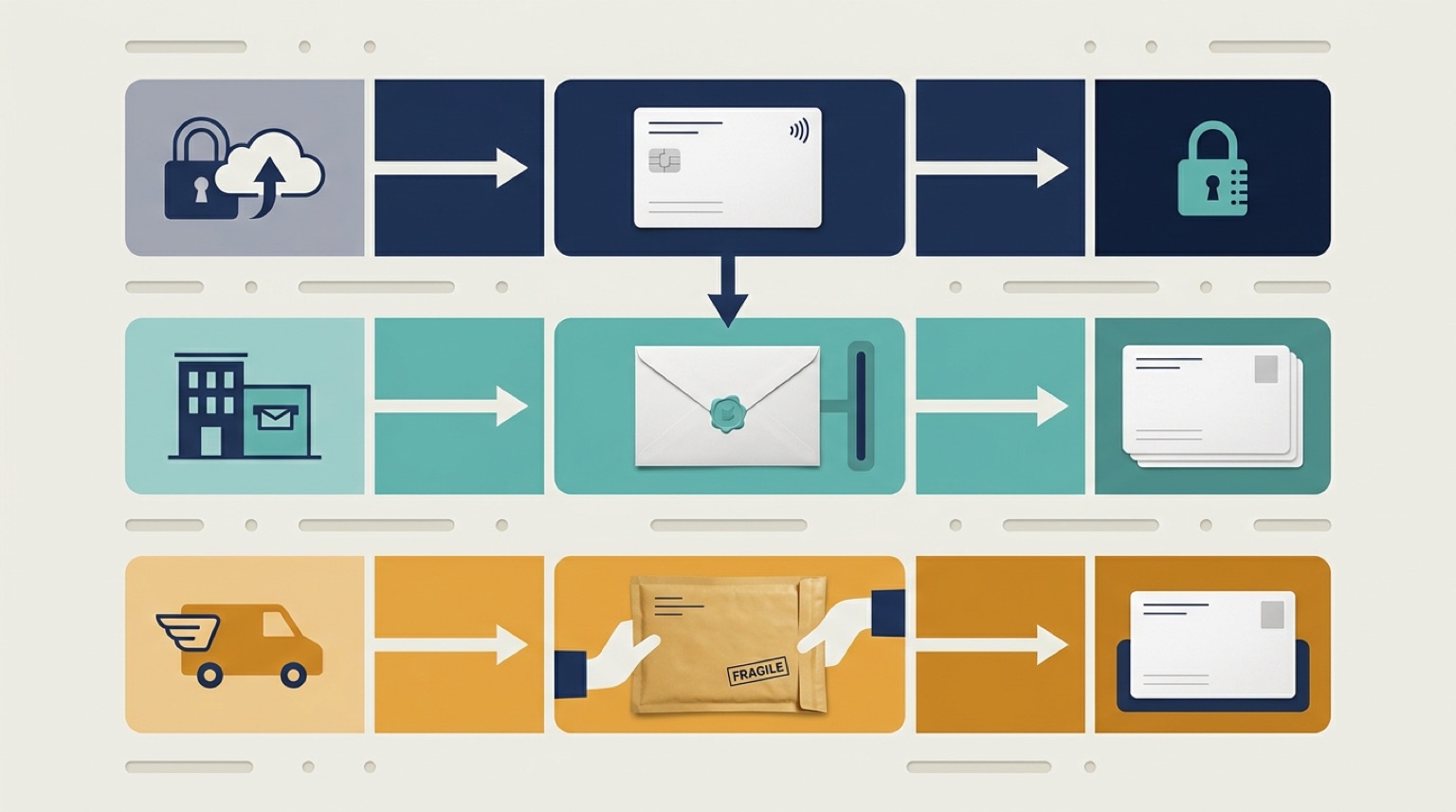
The submission method is set by the required-documents result, not by what another applicant did. Some routes are electronic, some are institution-sent, and some still need a sealed physical envelope. Two rules protect the file.
- Do not open an official sealed envelope when WES says it must remain sealed.
- Do not send a personal scan when WES says the institution or an approved source must send the record.
Keep courier receipts, electronic submission confirmations, and the reference number on everything.
Step 5, tracking the evaluation
Watch the WES account and email for document receipt, additional-document requests, and the decision. A received document is not the same as an accepted document. If WES asks for clarification, answer the specific request and keep the original source evidence. Processing time depends on document receipt, institution response, evaluation type, and additional requests, so use the current WES estimate rather than a fixed promise.
What usually delays a file
- A name mismatch. The credential, passport, and application must agree.
- The wrong institution result. A result for the wrong program means the wrong document set.
- An opened envelope. A sealed envelope that arrives open is no longer an official submission.
- The wrong HEC route. Using the CNIC form on an e-attestation file, or physical paperwork when the result expects the digital route.
- An unverified institution response. The university or HEC must respond to WES in the way the result specifies. A slow response delays the whole file.
When a file needs to move faster or the document set is unclear, eca document preparation support handles the Pakistan-side steps and keeps the WES reference number on every submission.
Sources
- WES required-documents search for Pakistan CNIC form rules, checked 12 August 2026
- HEC Degree Attestation System, checked 12 August 2026
- IRCC educational credential assessment guidance, checked 12 August 2026
- Alberta IQAS assessment for immigration, checked 14 August 2026
Frequently Asked Questions
Which is better, WES or IQAS for Canada?
Are WES and IQAS accepted by IRCC?
Does WES accept HEC e-attestation from Pakistan?
Do I need a CNIC form for WES with HEC e-attestation?
Does WES still need a sealed envelope?
How do I send documents to WES from Pakistan?
What does WES processing time depend on from Pakistan?

About Sannan Siddique
Sannan Siddique is the founder and CEO of Attestdone. He spent about ten years in logistics and compliance in the Gulf before returning to Pakistan, where he built Attestdone around written quotes, tracked document handling, and staff who file at the authorities themselves.
View author profile →On this page
- What an ECA is for
- WES vs IQAS and choosing the body that fits the case
- The Pakistan rule for e-attestation versus physical attestation
- Before you apply
- Step 1, the application and the reference number
- Step 2, the required-documents result for your institution
- Step 3, the HEC route your result asks for
- Step 4, sending documents the way WES specifies
- Step 5, tracking the evaluation
- What usually delays a file
- Sources
Want help with your ECA file?
We prepare the transcripts and HEC verification for your evaluator.
Get a Quote